


 即時新聞
即時新聞

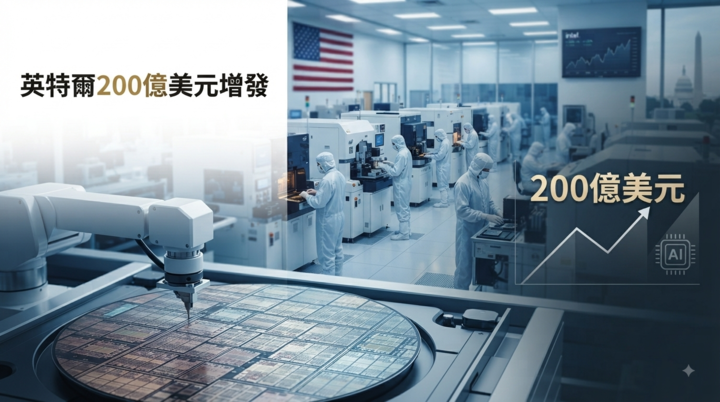
(Image/ AI image from Orange News )
Intel's $20 billion stock offering has attracted attention in the US market. The Trump administration decided not to participate in the new stock offering, but still expressed support for Intel's fundraising and transformation direction. The funds will further support its AI strategy and the development of its Ohio wafer fab.
Behind Intel's $20 billion fundraising: From government funding to private capital
Intel's $20 billion share offering has become a significant capital market event in the recent US semiconductor industry. Originally planning to raise $15 billion, Intel increased the size to $20 billion after securing cornerstone investor support. Reuters reported that the deal was ultimately priced at $95 per share, with Intel raising $20 billion through the expanded stock offering.
It's worth noting that the US government did not participate in the subscription, but this does not mean that Washington has become negative about Intel's strategic value. Semafor reported that Intel CEO Li-Wu Chen communicated with US Commerce Secretary Rutnick before preparing for the stock sale. Although the US government did not participate in this offering, it expressed support for the company's fundraising plan.
This makes the significance of this share issuance not just "how much money Intel needs," but also the market's observation: with the US government becoming a major shareholder of Intel, can Intel gradually shift from government support to market capital support in the future?
Why did the US government, which already holds shares in Intel, choose not to participate in this round of investment?
Intel's capital relationship with the U.S. government is actually quite different from the traditional model of corporate-government subsidies. In August 2025, the U.S. government and Intel reached an agreement in which the government acquired approximately $8.9 billion worth of Intel common stock, representing approximately 9.9% of the company's shares; the funds came from existing CHIPS Act funding and the Secure Enclave program.
Therefore, the government's non-participation in the $20 billion share issuance does not equate to Washington's withdrawal from Intel. On the contrary, the US government had already become a significant shareholder in Intel through equity ownership.
From a capital market perspective, this decision not to invest new funds forces Intel to demonstrate its fundraising capabilities and transformative value to the private market. For the company, completing a large-scale share issuance without additional government subscription is itself a signal for the market to assess Intel's recovery progress.
However, issuing new shares also means an increase in share capital, which will dilute the shareholding ratio of existing shareholders. This is one of the main factors contributing to the negative short-term market reaction to Intel's stock price after the announcement.
The $20 billion isn't just a simple bailout; Intel is betting the money on AI and wafer foundry services.
What truly draws market attention to this funding is Intel's plan to use it. Publicly available information indicates that one of Intel's core transformation strategies in recent years has been to strengthen its foundry business while investing in AI-related technologies and manufacturing capabilities. The company is also continuously advancing its advanced manufacturing footprint within the United States.
The Ohio wafer fab is a key part of Intel's U.S. manufacturing strategy. Intel's data shows that the company planned to build an advanced wafer fab in Ohio, with an initially announced investment exceeding $20 billion, which was later increased to over $28 billion.
Therefore, the $20 billion share issuance should not be viewed merely as a short-term financial boost for the company. It is more like a "transformation bet" in the capital market: Intel needs more funds to invest in advanced processes, wafer foundry, and AI-related opportunities, while also convincing investors that these large capital expenditures can ultimately translate into actual customer demand and revenue growth.
The stock price is under short-term pressure, but the market is also watching another matter.
Stock issuance typically leads to equity dilution, and Intel's case is no exception. Reuters reported that when Intel initially announced its $15 billion stock offering, its share price initially fell by about 4%; however, subsequent market expectations for the company's transformation and AI-related demand helped support the share price.
This presents Intel with a rather typical market dilemma: on the one hand, investors must face the dilution effect of a large number of new shares entering the market; on the other hand, if this funding can indeed help Intel expand its wafer foundry capacity and meet more customer demand, the new capital may also be transformed into medium- to long-term growth momentum.
In other words, what the market is really concerned about is not "why Intel is raising funds," but whether the $20 billion raised can create enough new value to offset equity dilution.
Intel's Transformation Enters the Next Phase: From Government Funding to Private Capital
Intel's funding sources have become increasingly diversified in recent years. In addition to equity investments from the U.S. government, the company has also raised funds through private placements in the past. In August 2025, Intel reached a $2 billion stock investment agreement with SoftBank, which provided funds to support the company's strategic investments.
Intel's 2026 proxy statement also mentioned that the company has increased capital in recent years through asset disposals, private placements, and agreements with the US government to support its strategic layout. This means that Intel's current capital strategy no longer relies solely on government subsidies or its own cash flow, but is gradually building a diversified financing structure that includes the government, strategic investors, and the public market. For a semiconductor company that requires massive capital expenditures, this shift in capital structure is quite important.
The real test Chen Liwu faces next: turning funds into orders.
With $20 billion in place, Intel's real challenges begin. Wafer foundry is a highly capital-intensive industry; factory construction, advanced process development, equipment investment, and capacity utilization all require long-term accumulation. Intel's official documents also indicate that the company continues to increase its investment in US-based manufacturing and considers Ohio a key location in its advanced chip manufacturing strategy in the United States.
Therefore, the market needs to observe at least three indicators in the future. First, whether Intel can translate AI demand into actual wafer foundry orders. Second, whether the construction and mass production progress of the Ohio wafer fab can gradually meet the expectations of the capital market. Third, whether the new capital expenditures can bring sufficient improvement in revenue and cash flow.
If Intel can continue to acquire customers and improve the utilization rate of advanced processes, the $20 billion share issuance may be reinterpreted by the market as a growth investment; conversely, if funds continue to be invested but customer base and capacity utilization do not improve in tandem, the negative effects of equity dilution may once again become the focus of the market.
The Trump administration's attitude is also changing: from direct shareholding to policy support.
Another noteworthy signal from this incident is the changing relationship between the US government and Intel. By 2025, the US government had directly participated in Intel's capital structure by acquiring approximately 9.9% of its shares, linking US semiconductor manufacturing and national security objectives with the company's development.
In this latest $20 billion share issuance, the government did not invest any further funds, but still expressed support for Intel's fundraising. This approach may indicate that Washington wants to maintain strategic support for key semiconductor companies while reducing the need for continued public funding. On the other hand, Intel must also prove the commercial viability of its transformation plan through the public market and private investors.
Therefore, the significance of this share issuance goes beyond simply raising funds for a single company. It also reflects that US semiconductor policy is seeking a new balance: the government provides strategic support, but companies ultimately need to rely on market capital and actual business results to prove their value.
After $20 billion, can Intel truly turn things around?
Intel's $20 billion stock offering addresses its short-term funding needs, but in the medium to long term, it must answer questions about its business model and competitiveness. The company now has more capital and continues to advance its domestic wafer manufacturing and AI-related initiatives in the US; however, the semiconductor industry is highly competitive, and massive capital investment does not guarantee success.
For investors, the most important signal going forward will gradually shift from "how much money was raised" to "how many orders, how much capacity utilization, and how much cash flow this money will generate." Intel's $20 billion share issuance is a significant milestone in its transformation funding, but whether it can become a true turning point depends on foundry customers, AI demand, and the results of advanced process technology implementation.
Orange News
(Text by reporter Guo Wenya)

 536
536
 Sep 25, 2026








評論